
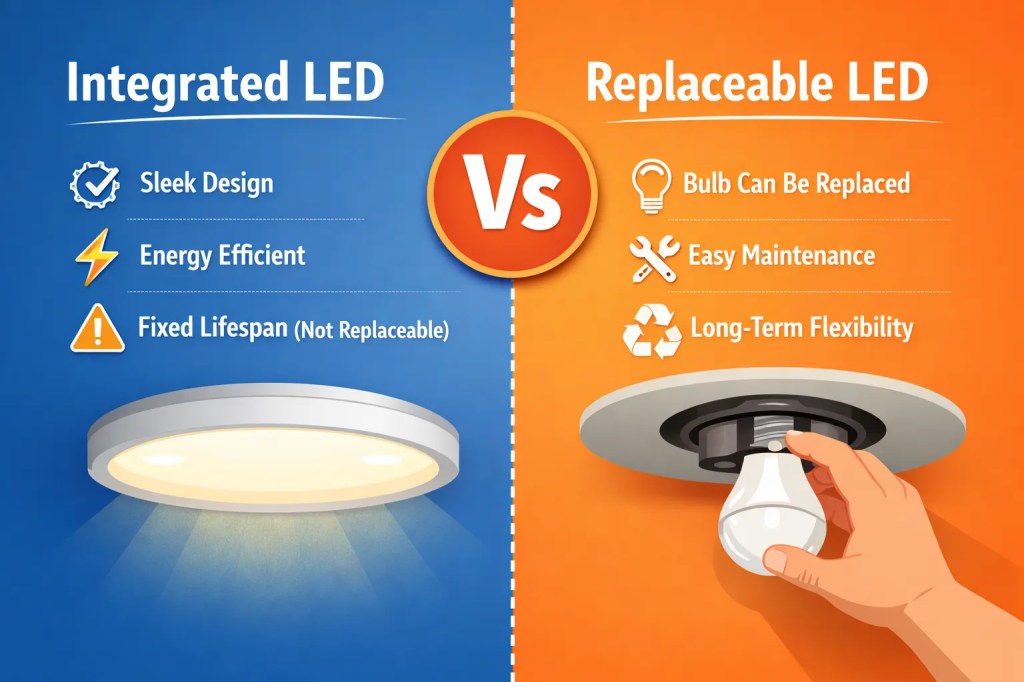
In today’s lighting market, one of the biggest decisions homeowners, contractors, and designers face is choosing between replaceable LED lamps and integrated LED fixtures.
At first glance, integrated LED fixtures can seem like the modern choice. They’re sleek, compact, and marketed as “maintenance-free.” But when you look deeper, replaceable LED systems offer clear long-term advantages that make them the smarter investment.
If you care about cost, flexibility, and future-proofing your lighting, here’s why replaceable LED lamps come out ahead.
1. Lower Long-Term Cost: Replace the Bulb, Not the Fixture
One of the biggest drawbacks of integrated LED fixtures is simple:
when they fail, the entire fixture has to be replaced.
That means:
- Removing the fixture
- Rewiring or reinstalling
- Paying for a completely new unit
With replaceable LED lamps, the solution is much easier and cheaper:
✔ Swap the bulb
✔ Keep the housing
✔ Get back up and running in minutes
Over time, this leads to significant cost savings, especially in:
- Large homes
- Multi-unit buildings
- Commercial spaces
Bottom line: Replaceable LED systems dramatically reduce maintenance and replacement costs over the life of the product.
2. Future-Proof Your Lighting Investment
Lighting technology evolves quickly. What looks cutting-edge today may feel outdated in just a few years.
Integrated LED fixtures lock you into:
- A fixed brightness
- A fixed color temperature
- A fixed beam pattern
With replaceable LED lamps, you’re never stuck.
You can easily upgrade to:
- Brighter or more efficient bulbs
- Warmer or cooler color temperatures
- New lighting technologies as they emerge
This means your lighting system evolves with you, without needing a full replacement.
3. Maximum Flexibility for Any Space
Lighting isn’t one-size-fits-all. Different spaces require different effects:
- Warm, soft lighting for living rooms
- Bright, focused lighting for kitchens
- Accent lighting for artwork or architecture
With replaceable LED lamps, you can adjust your lighting anytime:
✔ Change beam angles (spot, flood, wide)
✔ Switch color temperatures (2700K, 3000K, etc.)
✔ Adapt lighting as your space or design changes
Integrated fixtures, on the other hand, are fixed from day one.
Flexibility isn’t just a convenience, it’s a major design advantage.
4. Environmentally Friendly: Less Waste, More Sustainability
Sustainability is becoming a major priority in both residential and commercial construction.
Integrated LED fixtures contribute to more waste because:
- The entire fixture is discarded when it fails
- Electronics, metals, and materials go to landfill
Replaceable LED systems are far more sustainable:
✔ Only the lamp is replaced
✔ The housing stays in place for years or decades
✔ Less material waste overall
For builders and businesses focused on green building practices, this is a major advantage.
5. Faster Maintenance and Reduced Downtime
In real-world applications, especially in commercial or multi-unit settings, downtime matters.
Integrated LED failure often means:
- Scheduling repairs
- Removing fixtures
- Longer service time
Replaceable LED systems simplify everything:
✔ Quick lamp swap
✔ No rewiring
✔ Minimal disruption
This makes them ideal for:
- Rental properties
- Offices
- Retail spaces
- Hotels and hospitality
The Verdict: Replaceable LED is the Smarter Long-Term Choice
While integrated LED fixtures may offer a clean, all-in-one design, they come with trade-offs that become clear over time.
Replaceable LED systems deliver:
- Lower lifetime cost
- Future-proof flexibility
- Greater design control
- Reduced environmental impact
- Easier maintenance
For anyone thinking beyond the initial purchase, replaceable LED is the more practical and strategic choice.
Final Thought
Lighting should work for you today and adapt to your needs tomorrow.
By choosing replaceable LED lamps, you’re not just buying a fixture, you’re investing in a flexible, upgradeable lighting system that stands the test of time.



 100% Canadian Owned
Leave a comment